Follow Me on Pinterest

Cool Facts

Solar System & Planets -Interesting Facts

1st about Universe & Space

  • The universe is probably 15 billion years old but the estimations vary.
  • There are more stars than all of the grains of sand on Earth.
  • In space, astronauts cannot cry, because there is no gravity, so the tears can't flow.
  • A person of 60 kgs weight barely will weigh 10 kg on Moon, but 1,680 kg on the Sun.That means ,you would weigh 1/6th of your weight on Moon & 24 times more on Sun.This happens due to gravitational pull at different places.
  • Sirius (Dog star )is much brighter than the sun. In fact, no star is as bright as SirIus.

See free education video on Solar System & many more by clicking here Science Learning for 6-12 years old kids

  • If you shouted in space even if someone was right next to you they wouldn't be able to hear you as there is no air to carry your message .
  • A light year is the distance light travels in a year .
  • Galileo was the first scientist to look ar night sky through a telescope.

All about Solar System ,Planets

What is Solar System ?

  • The Sun, its planets and all the objects moving around them collectively are called Solar System.
  • If you are having problems remembering the planets in their correct order, just remember this sentence "My Very Educated Mother Just Served Us Naan," Mercury, Venus, Earth, Mars, Jupiter, Saturn, Uranus, Neptune.
  • Origin of some celestial words :Planet word comes from Greek word planasthai ;which means to wander, Satellite word comes from Latin word satelles ;which means attendant, Solar also comes from a Latin word solaris meaning Sun
  • The solar system is in a galaxy known as "the milky way".
  • About 99.86 percent of the mass of the Solar System is made up of the Sun.
  • The sun's strong gravitational pull holds Earth and the other planets in place.
  • The Solar System is entirely dependent on Sun & the only one which is self- luminous i.e which has its own light.
  • Rest of the planets reflect the light received from Sun.
  • There were nine planets, until Pluto was downgraded to dwarf planet status in 2006.

Facts - The Sun :Star of the Family

See free education video on Solar System & many more by clicking here Science Learning for 6-12 years old kids

  • Sun is the heaviest among solar system
  • Sun is a ball of hot ,burning gases.
  • Sun is the nearest star to the earth.
  • Sun is the source of all energy for life on Earth.
  • About three quarters of the Sun's mass consists of hydrogen, while the rest is mostly helium.
  • On the Sun's surface ,there are dark patches known as sunspots. These are patches of gas that looks dark since they are cooler than their surroundings.
  • The light from the Sun takes appx. 8 minutes to reach Earth.
  • It takes about 1.25 seconds for moonlight to reach the Earth whereas sunlight reaches earth in 8 minutes 19 seconds, so you can judge how close moon is to us & how far sun is from earth

Planets Facts :The Sun's Family

  • Planet word comes from Greek ,which means wandering star.
  • Planets are heavenly bodies ,which revolve around the Sun in elliptical orbits.
  • Earlier it was considered there were 9 planets in Solar system but lately one planet called Pluto was de-classified from being a planet.
  • All planets fall in 2 groups Inner Planets: Mercury , Venus, Mars and Earth are called inner planets. Outer Planets: These are Jupiter , Saturn, Uranus, Neptune.
  • Between Inner & Outer Planets ,there is a ring of small bodies , which are made of rock & metal, these are called Asteroids. They also keep moving around the Sun .This ring is also called Asteroids Belt.

Mercury : Inner Most Planet

  • Mercury is named after messenger of the Roman gods.
  • Mercury is the closest planet to the Sun.
  • Mercury has large variations in day (400 degree C) & night (-180 degree C) time temperatures.
  • Mercury is also the smallest, and its orbit is the most not fully circular.
  • Mercury does not have any satellite.
  • There is no water or atmosphere on Mercury.
  • Mercury can be seen with naked eyes.
  • A year at Mercury is of 88 days as it takes Mercury 88 days to orbit the sun, so Mercury has shortest year among all planets
  • There are no seasons on Mercury's surface

Venus Facts: The Veiled Planet

See free education video on Solar System & many more by clicking here Science Learning for 6-12 years old kids

  • Venus is surrounded by thick cloud cover ,that is why it is called "Veiled Planet".
  • Venus is brightest & hottest planet.
  • Venus is named after Roman goddess of love & beauty .Sometimes it is also referred as Planet of romance.
  • Venus orbits the Sun once in about 225 Earth days.
  • Venus reaches its maximum brightness shortly before sunrise or shortly after sunset, so it is also known as the Morning Star or Evening Star.
  • Venus is also known as "Sister " or "Twin" planet to earth because of its similar size & mass to earth.
  • Venus is the brightest planet in our sky and can sometimes be seen with the naked eye if you know where to look. It is also the brightest planet.
  • Venus is covered by thick clouds ,so it reflects lot of sunlight making it brightest planet.Also it is the hottest planet of solar system
  • Venus rotates so slowly that its one typical day lasts approximately 244 Earth days (5,856 hours). It has the slowest rotation in solar system

Earth Facts –The Blue Planet

See free education video on Solar System & many more by clicking here Science Learning for 6-12 years old kids

  • It is also known as watery planet, because 70% of its surface is covered by water. .
  • It reflects about 1/3rd of sunlight it receives .The earth’s atmosphere scatters the light & creates a blue effect, so it is also called Blue Planet. .
  • It is the only planet having life. .
  • It orbits the Sun once in about 365 Earth days. .
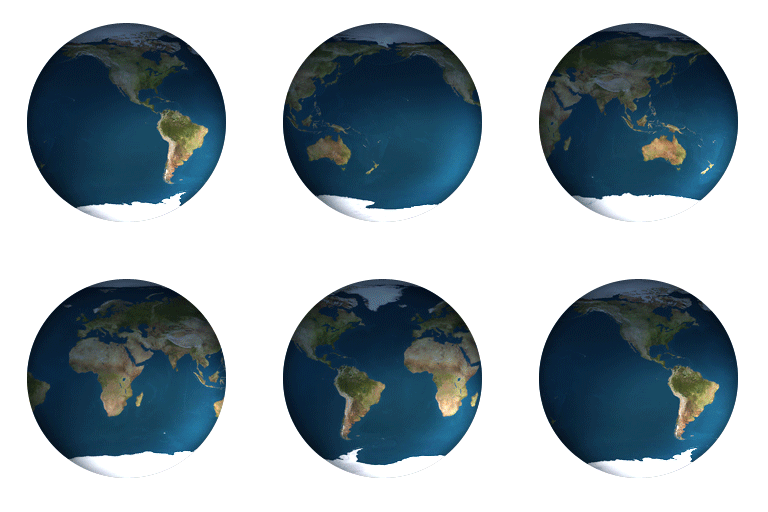
  • It rotates about its own axis, thus creating day & night. It takes 24 hours to do that. .
  • It revolves around sun, due to its tilt, seasons are created. .
  • Due to gravity, the layer of gases remains attached to it (which is known as atmosphere), it prevents too much heat or UV rays from Sun reaching earth. .
  • Moon is the only satellite of the Earth. .

Moon – Earth’s Only Satellite

  • It’s diameter of only 1/4th of the Earth.
  • It looks bigger to us as it is very close to us. .
  • The moon has no atmosphere ,so there is huge difference between day & night temperature. (127 degree C in Day to -173 degree C in Night) .
  • As there is no atmosphere, there is no weather, no rain, no wind or clouds. .
  • Like everything else in Solar System, Moon also does not have its own light . It shines due to Sun’s light. .
  • The Moon can be very hot during the day but very cold at night time. The average surface temperature can go up to 107 degrees Celsius during the day and can touch -153 degrees Celsius at night .
  • There is no water on its surface. .

See free education video on Solar System & many more by clicking here Science Learning for 6-12 years old kids

  • Moon’s gravity is 1/6th of Earth, so your weight would be 1/6th of your weight on the earth. .
  • The Moon is the only celestial body other than Earth on which humans have set foot. .
  • A full moon is nine times brighter than a half moon.
  • When the moon is directly over your head, you weigh slightly less.
  • Like the Earth, there are mountains on moon's surface.Mons Huygens is the tallest mountain on its surface, it is 4700 metres tall which is just over half the height of Mt Everest (8848m).
  • Neil Armstrong became the first person to walk on the Moon as the commander of the American mission Apollo 11 on 21 July 1969. .

Mars Facts–The Red Planet

  • Mars has approximately half the diameter of Earth.
  • It has two satellites.
  • The gravity of Mars is half of the earth .
  • The atmosphere of Mars consists of about 95% carbon dioxide, 3% nitrogen,1.6% argon and contains some oxygen and water.
  • Mars also has the largest dust storms in the Solar System.
  • Mars is named after the Roman god of war.
  • Mars is often described as the "Red Planet", as the iron oxide prevalent on its surface gives it a reddish appearance.
  • Mars has approximately half the diameter of Earth.
  • It has two satellites.
  • The gravity of Mars is half of the earth .
  • The atmosphere of Mars consists of about 95% carbon dioxide, 3% nitrogen,1.6% argon and contains some oxygen and water.
  • Mars also has the largest dust storms in the Solar System.

Jupiter Facts–The Giant Planet

See free education video on Solar System & many more by clicking here Science Learning for 6-12 years old kids

  • It is named after the Roman god Jupiter (ruler of Roman gods) .
  • Jupiter is the largest planet within the Solar System.
  • It has a great Red Spot, it is rotating storm system inside the planet.
  • Jupiter rotates faster than any other planet. .
  • It completes one rotation in 10 hours.
  • Jupiter has a faint ring system; these rings appear to be made of dust. .
  • This is also a windy planet as the fast rotation causes high winds. .
  • It has 16 planets. .
  • Jupiter is so big that you could fit all the other planets in the solar system inside it.
  • Jupiter has the shortest day of all the planets. Jupiter manages to make one turn in 9 hours and 55 minutes. It is because it has the fastest rotation speed in Solar system
  • Jupiter is the solar system's vacuum cleaner, pulling in meteors,dust and comets.
  • On Jupiter ,one would weigh 2.4 times more as compared to earth because gravity here is higher than the Earth,that means if you weigh 100 pounds on the Earth then on Jupiter ,it would be 240 pounds .
  • Do you what are Gossamer, Main and Halo?These are the names of 3 rings ,which are around Jupiter, but they are very faint and can be viewed only when Jupiter passes in front of Sun.

Saturn Facts–The Jewel Planet

  • Saturn is the sixth planet from the Sun and the second largest planet in the Solar System, after Jupiter.
  • It is named after the Roman god Saturn
  • Saturn is classified as a gas giant planet
  • It has 22 known satellites.
  • It can be seen by naked eye
  • Saturn is 95 times heavier than earth
  • It takes Saturn 10,759 Earth days (or about 29½ years), to finish one revolution around the Sun.
  • Saturn is the furthest planet from Earth that can be seen without the help of a telescope.
  • Saturn has such a low density that it would float if put in water!
  • Saturn is the second biggest planet, but it's also the lightest planet.
  • Saturn's rings are made of many pieces of rocks & ice.
  • Saturn has the greatest number of known moons of any planet in the solar system.

Uranus Facts –A planet on its side

  • Uranus appears to lie on its side.
  • It is named after the Roman god of the sky. .
  • The only planet, which rotates on its axis from east to west. .
  • It has at least ten thin uniform black rings, which are made of dust. .
  • It has 27 known satellites.
  • It is a very cold planet; it receives 370 times less sunlight than Earth as it is far away from sun as compared to Earth. .
  • Its core is very rocky.
  • It has at least ten thin uniform black rings ,which are made of dust. .
  • It has 27 known satellites.
  • It is a very cold planet ,it receives 370 times less sunlight than Earth as it is far away from sun as compared to Earth. .
  • Uranus is tilted in such a way that a season lasts there for 20 years.

Neptune Facts –The Last Giant

See free education video on Solar System & many more by clicking here Science Learning for 6-12 years old kids

  • Can’t be seen with naked eye.
  • It has 8 known satellite.
  • As it is very far from Sun, it completes an orbit on average every 164.79 years.
  • The average distance between Neptune and the Sun is 4.50 billion km.
  • Neptune was the first planet found by mathematical prediction.
  • Neptune is known to be the coldest planet in Solar system, also it has slowest revolution speed in solar system.

Compiled by R.Ravndharan ,Hyderabad